
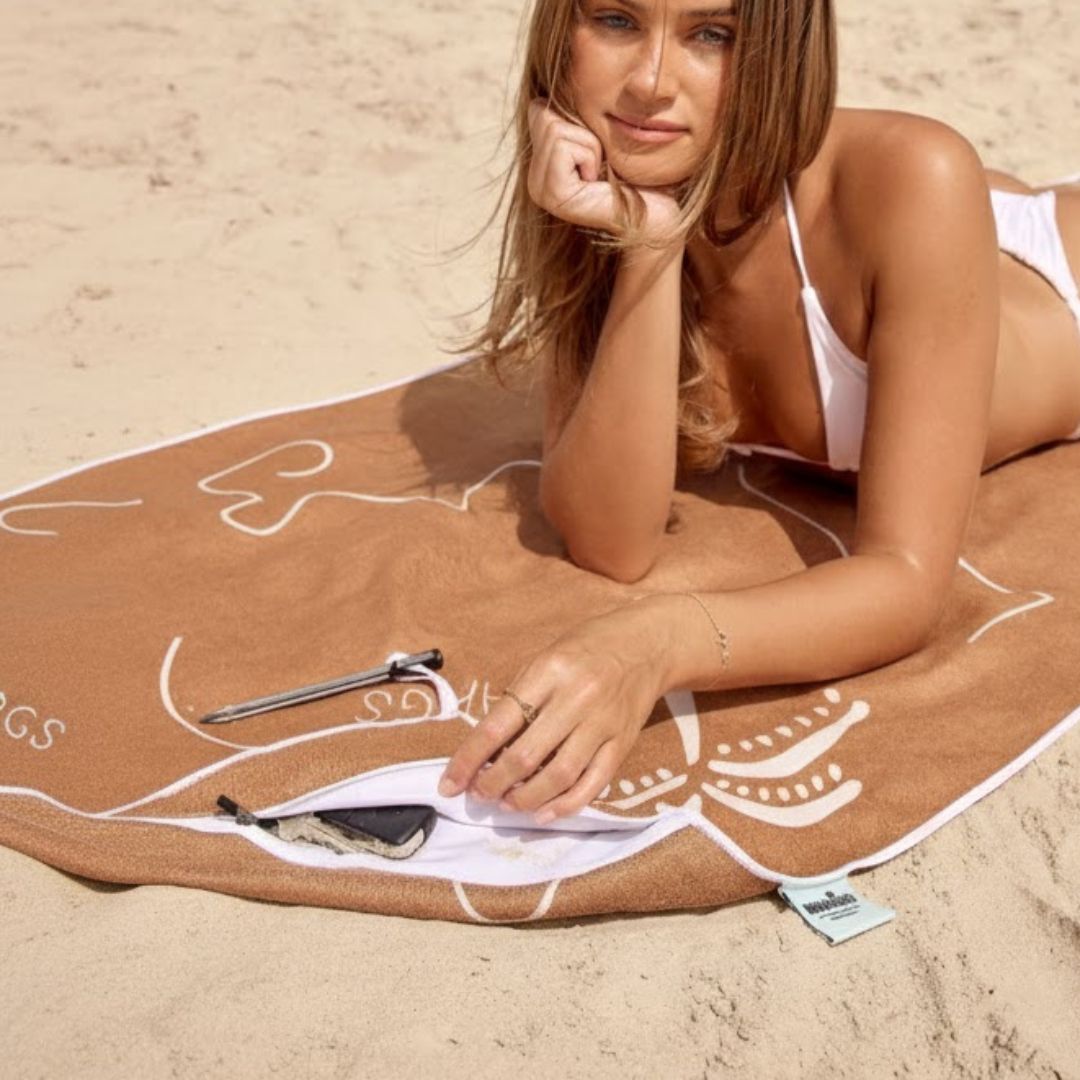
If you've been shopping for a new beach towel and gotten lost in the "sand-free vs microfibre" rabbit hole — let me save you the next two hours of forum reading.
This is the complete 2026 guide to sand-free beach towel vs microfibre towel — the actual difference between the two terms, why they're not interchangeable, and how to pick the right one for the way you actually use the beach. Includes the test that separates a real sand-free towel from a microfibre that just claims to be.

The Short Answer (For Skim Readers)
Most sand-free beach towels ARE microfibre — the terms overlap. Microfibre is the fabric. Sand-free is what that fabric does when you shake it. Cheap microfibre still holds sand. Quality microfibre sheds it. The question isn't "which one" — it's "which microfibre construction."
What Is a Microfibre Towel?
Microfibre is a synthetic fabric woven from ultra-fine fibres (each strand is less than 1/100th the width of a human hair). It absorbs more water than cotton, dries 3x faster, weighs about half, and packs down to a fraction of the size.
The original microfibre towels were marketed as "travel towels" or "gym towels" — small, packable, sweat-absorbent. The 2026 generation has scaled up to full beach-towel size while keeping the pack-down and quick-dry advantages.
What Makes a Towel "Sand-Free"?
A sand-free beach towel is one specifically engineered so sand doesn't stick to it. The mechanism: tight-weave microfibre with no loops or pile for sand grains to grab onto. Shake once, sand falls off. Shake twice, the towel is clean.
Traditional cotton (terry-cloth) beach towels have a looped pile structure — sand grains nest between the loops and stay. Even a thorough shake leaves 30–50% of the sand behind. Microfibre's flat woven surface gives sand nowhere to hide.
So the connection: all true sand-free beach towels are microfibre, but not all microfibre towels are properly "sand-free."
The Sand-Free Test
The way to know if a microfibre is genuinely sand-free:
- Lay the dry towel on dry sand.
- Scrunch it into a ball for 5 seconds.
- Shake it out once.
A quality sand-free towel sheds 95%+ of the sand on the first shake. A cheap microfibre holds maybe 50%. A cotton towel holds 70%+. The test takes 30 seconds and is the only reliable way to compare.

Sand-Free Beach Towel vs Microfibre Towel: The Real Comparison
Material
Same. Both are microfibre. The difference is the weave density — a sand-free towel uses a tight, flat weave; a generic microfibre uses a looser, sometimes piled construction.
Drying Speed
Both dry fast. Sand-free towels are typically slightly faster (less material per square cm). Both dry in 10–20 minutes in direct sun vs 2+ hours for cotton.
Absorbency
Microfibre absorbs 3–4x its weight in water. Sand-free versions absorb 3x (slightly less than the deepest-pile microfibres) but enough for any beach or pool use.
Pack Size
Both pack small. A standard 160 × 80 cm sand-free beach towel packs down to about 1.5 litres — the size of a paperback book. A traditional thick cotton beach towel takes up 5 litres.
Comfort
This is where preferences differ. A traditional cotton towel feels plush — like a bathrobe. A microfibre / sand-free towel feels smooth and slightly textured, closer to suede. Some travellers prefer cotton for pure lounging; most prefer microfibre once they're used to the texture.

Sand Behaviour
The whole point. A real sand-free towel shakes clean. A generic microfibre is slightly better than cotton but still holds a lot of sand. This is where construction quality matters most.

What to Look for in a Sand-Free Microfibre Towel
1. Tight Weave (Not Loose)
Run your fingers across the fabric. A quality sand-free towel feels slightly textured but smooth — almost like suede. A cheap microfibre feels slippery, with fibres you can pluck at. Loose weave = holds sand.
2. Sublimation-Printed Pattern
The good ones use sublimation printing — the dye is bonded into the fibre. Cheap towels use surface printing, which fades and peels after a few washes.
3. Water-Resistant Zip Pocket
The 2026 must-have. A beach towel with a zip pocket means your phone, keys, and cards are secure while you swim. Read our beach towel with zip pocket buyer's guide for the deep-dive.
4. Pegs Included
A lightweight sand-free towel catches wind. Pegs go from nice-to-have to essential. Every Nomadique towel includes four.
5. Size
Standard 160 × 80 cm for solo use. XL 200 × 100 cm if you're tall or sharing. See our XL beach towel guide for the size breakdown.
Sand-Free Beach Towel vs Microfibre: Which Should You Buy?
Three buyer profiles:
If You Travel Frequently → Sand-Free Microfibre
The pack-down + quick-dry combo wins. A sand-free travel towel with a zip pocket is the single most useful $42 you'll spend on travel gear.
If You Live at Aussie Beaches → Sand-Free Microfibre
Aussie sand is fine and gets everywhere. A sand-free towel is non-negotiable. Our Burleigh print or XL Noosa are the Aussie picks.
If You Want a Plush "Stay at the Beach House" Towel → Cotton
If you want pure bathrobe-feel and never need to pack the towel, traditional terry cotton is comfier. Just keep it at the beach house — never travel with it.

Sand-Free vs Microfibre FAQs
Is sand-free the same as microfibre?
Mostly yes. Microfibre is the fabric; sand-free is what good microfibre does. Cheap microfibre still holds sand; quality sand-free microfibre doesn't.
Are sand-free beach towels actually sand-free?
Quality ones, yes — 95%+ sand release on a single shake. Cheap ones still hold sand. Construction quality is everything.
Do microfibre towels dry your skin properly?
Yes — they absorb 3–4x their weight in water. The texture is sleeker than terry cotton but the drying performance is equivalent.
Are microfibre beach towels good for kids?
Yes — lightweight (easier for kids to carry), quick-dry (no wet towel in the car), sand-free (no full-body sand baths). The smarter family-beach choice.
Why are sand-free beach towels more expensive?
Quality construction. Tight-weave microfibre, sublimation printing, water-resistant pocket lining, included pegs. All add cost. The cheap microfibres skip these.
Can I use a sand-free beach towel at the pool?
Yes — they work brilliantly at the pool. Lighter than cotton, dries faster between swims, and the zip pocket keeps your phone safe pool-side.
The Verdict
Don't think of it as "sand-free vs microfibre." Think of it as "cheap microfibre vs quality sand-free microfibre." The cheap stuff fails the shake test. The quality stuff shakes clean every time and lasts five years.
Our pick for most readers: a Nomadique Voyager Sand-Free Beach Towel With Pocket ($42) — tight-weave microfibre, water-resistant zip pocket, four pegs, sublimation-printed. The benchmark for "what a sand-free travel towel should be."
For the full buyer's guide, read our best sand-free beach towels Australia 2026 ranking. For the travel-towel category overview, see our best travel towel 2026 guide.

Leave a comment
This site is protected by hCaptcha and the hCaptcha Privacy Policy and Terms of Service apply.